The Quick answer: If a tree has fallen or is hanging dangerously after a storm in Kent, keep everyone well clear, call 105 if it is touching power lines, and call Kent County Council on 03000 41 81 81 (03000 41 91 91 out of hours) if it is blocking a road. Photograph everything, call your insurer, then get a qualified tree surgeon to make it safe. If the tree is protected by a Tree Preservation Order or stands in a conservation area, you must notify your council in writing, even in an emergency.
Storm Austen and Storm Boelo hit Kent on consecutive days in late October 2026 and brought trees down from Maidstone to Sevenoaks. If one of those trees was yours, or is now leaning, split or hung up in its neighbour, this guide sets out exactly what to do, in order, with the Kent phone numbers, the legal rules and realistic costs. It is written by Broadleaf Tree Surgery, a Maidstone firm founded in 2015 that handles emergency tree work across Maidstone, Medway, Gravesend, Sittingbourne and Sevenoaks.
What happened in Kent during Storm Austen and Storm Boelo?
The Met Office named Storm Austen on 22 October 2026 and described it as “the first stormy weather in the south of the UK this season”, with yellow wind warnings for gusts of 45 to 55mph across much of England. Kent Highways logged fallen trees on Ashford Road in Maidstone, the A229 between Staplehurst and Cranbrook, Forsham Lane in Sutton Valence, Park Lane at Godden Green near Sevenoaks, Kemsing Road in Wrotham and the A225 at Otford. Trees also blocked railway lines at Snodland, Meopham and Teynham.
Storm Boelo followed on 24 and 25 October with heavy rain, bringing down more trees on Rayners Hill near Lenham, Forsham Lane again, and the A228 at Pembury (KentOnline, 24 October 2026).
Why October storms bring down so many trees. In late October most broadleaf trees still carry a full canopy. A tree in leaf acts like a sail, catching far more wind than the same tree in January. Add rain-softened clay soils, which hold roots less firmly, and trees with hidden decay or weak forks fail first. We explain the biomechanics in more detail in Why Do Trees Fall Over In A Storm?
What should I do first if a tree has fallen?
Work through these steps in order. Safety comes before property, and evidence comes before clearing up.
- Keep people and pets away. Stay at least one and a half times the tree’s height from any tree that is leaning, cracked at the base or hung up in another tree. Hung-up trees and snapped branches still in the canopy (arborists call them “hangers”) can drop without warning.
- Check for power lines. If a tree or branch is touching overhead cables, assume they are live. Call UK Power Networks on 105 (or 0800 31 63 105). Do not try to move anything.
- If anyone is hurt or trapped, call 999.
- If it is blocking a road or pavement, call Kent County Council Highways on 03000 41 81 81 (Monday to Friday, 9am to 5pm) or 03000 41 91 91 at all other times. In Medway, report it to Medway Council, which manages its own roads.
- Photograph and video everything before anything is moved: the root plate, the break point, any fungus, the damage, and the tree’s position relative to your boundary. Your insurer and, if the tree is protected, your council will want this.
- Call your insurer before agreeing to non-urgent work, unless the tree poses an immediate danger. Most insurers accept that emergency make-safe work cannot wait.
- Check whether the tree is protected (see the permissions section below).
- Call a qualified, insured tree surgeon to make the site safe. Do not attempt it with a chainsaw yourself; see the next section for why.
Is it safe to cut up a fallen tree myself?
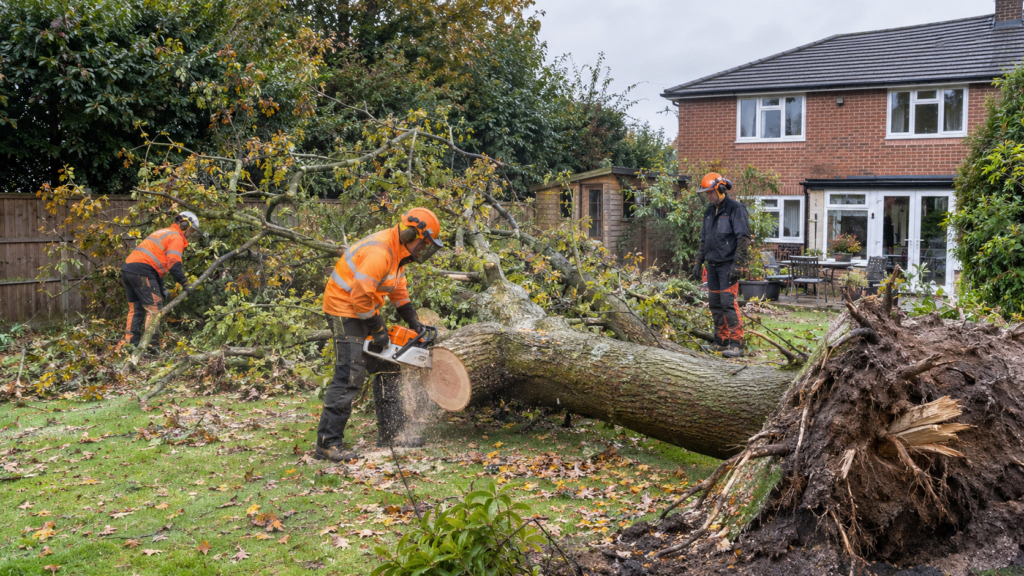
Usually not. A fallen or wind-damaged tree is one of the most dangerous things an arborist deals with, because the wood is under tension and compression that you cannot see. When you cut a trunk or branch that is bent, pinned or twisted, it can spring sideways or roll with enough force to break bones. The root plate of an uprooted tree can also tip back upright when the trunk is cut free.
Professional storm work follows a set order: assess the loads, secure hangers with ropes, release tension in controlled cuts, then dismantle in sections. Broadleaf’s team holds NPTC chainsaw and climbing qualifications for exactly this kind of work, and Aaron has carried out complex removals in Norway, Sweden, Germany and Australia, where storm-thrown timber is routine. If a small branch has fallen on open lawn and nothing is under tension, clearing it yourself is reasonable. Anything bigger than that, or anything attached to a standing tree, is a job for a professional.
Who do I call? A Kent quick-reference table
| Situation | Who to call | Number or route |
|---|---|---|
| Someone hurt or trapped | Emergency services | 999 |
| Tree on or near power lines | UK Power Networks | 105 or 0800 31 63 105 |
| Tree blocking a road or pavement (Kent) | Kent County Council Highways | 03000 41 81 81 (weekdays 9 to 5), 03000 41 91 91 (other times) |
| Tree blocking a road (Medway) | Medway Council | Report via medway.gov.uk |
| Tree on a public footpath | KCC Public Rights of Way | 03000 41 71 71 |
| Tree on a railway line | Network Rail | 03457 11 41 41 (24 hours) |
| Protected tree (TPO or conservation area) | Your borough council’s tree officer | Written notice, see below |
| Fallen, split or leaning tree on your land | A qualified tree surgeon | Broadleaf emergency tree surgery, 0800 999 5323 |
Sources: Kent County Council, Tunbridge Wells Borough Council. Numbers checked November 2026.
Note that if your tree falls onto a public road, Kent County Council will cut it back to reopen the road, leave the cuttings on your property and may recover its reasonable costs from you as the landowner.
Do I need council permission to remove a storm-damaged tree in Kent?
If the tree is not protected, you do not need permission to clear it from your own land. If it is covered by a Tree Preservation Order (TPO) or stands in a conservation area, there is a limited exception for dead and dangerous trees under the Town and Country Planning (Tree Preservation) (England) Regulations 2012, but it comes with strict conditions.
- Dangerous trees: you can do the minimum work needed to remove an immediate risk of serious harm, then give the council written notice “as soon as practicable” after the work became necessary.
- Dead trees: you must give at least five working days’ written notice before removing them. Dying or merely damaged trees do not qualify.
- Only the minimum: the exception covers making the tree safe, not tidying the whole crown or felling a tree that could have been reduced.
- Replacement planting: where a protected tree is removed under this exception, the landowner usually has a duty to plant a replacement of suitable size and species in the next planting season.
- Evidence: Kent councils such as Thanet and Tunbridge Wells ask for clear photographs of the defect and a written statement from a competent arborist. Without this, you risk prosecution.
Unauthorised work on a protected tree can lead to a fine of up to £20,000 per tree in a magistrates’ court. Maidstone, Tonbridge and Malling, Sevenoaks, Swale, Gravesham and Medway councils each run their own TPO maps and notice forms, so check your own council. For the basics of protection orders, see our guide What Is a Tree Preservation Order?
When Broadleaf attends a protected tree after a storm, we photograph the defect, limit the work to what makes it safe and give you a written statement to send with your notice.
Who pays if a tree falls in a storm?
In most cases each property owner claims on their own buildings insurance, regardless of whose tree it was. The tree owner is only liable if they were negligent, for example if they had been told the tree was dangerous and did nothing about it. Storm damage from a well-maintained tree is usually treated as an accident that nobody could reasonably have foreseen.
| Scenario | Who usually pays | What to check |
|---|---|---|
| Your tree falls on your house | Your buildings insurer | Storm cover, excess, whether tree removal is included |
| Your neighbour’s tree falls on your house | Your buildings insurer | Whether your neighbour had been warned the tree was unsafe (negligence) |
| Your tree falls on your neighbour’s property | Their buildings insurer, unless you were negligent | Your inspection records; your liability cover |
| Tree falls but damages nothing | Usually you, as landowner | Some policies cover removal only when the building is damaged |
| Tree damages a fence or shed | Varies by policy | Many policies limit or exclude fences, gates and hedges |
| Your tree blocks a public road | KCC clears the road and may recharge you | Whether the tree had been inspected |
Insurers differ on two points that matter after a storm. Some policies cover the cost of removing a tree that fell in an insured storm, while others treat removal as “generally not covered” unless it damaged the insured building. Fences and gates are also treated inconsistently. Read your own policy wording before assuming either way. On the legal position, see Frettens Solicitors. This is general information, not legal advice.
The practical lesson: a written tree inspection is your best evidence that you met your duty of care. If a neighbour has raised concerns about one of your trees, act on them and keep the paperwork.
How much does emergency tree removal cost in Kent?
There is no honest fixed price, because storm work varies more than any other tree job. As a guide, Broadleaf’s labour rate is £40 to £60 + VAT per person per hour, and most domestic storm call-outs need a team of two to four. A simple job, such as clearing a fallen 25ft conifer from an open lawn, may be a few hours’ work. A large tree resting on a roof, hung up in another tree or lying across a boundary can take a full day or more and may need a MEWP (cherry picker) or crane.
For a national reference point, Checkatrade’s June 2026 guide puts planned felling of a tree up to 25ft at £240 to £340 and a 50ft tree at £1,190 to £1,720, excluding VAT (Checkatrade). Storm work often costs more than planned felling of the same tree because of the extra time spent releasing tension and working around damage.
| Cost factor | Why it moves the price |
|---|---|
| Size and species | Larger trees and dense hardwoods take longer to section and produce more waste |
| Tension and hang-ups | Loaded timber has to be released slowly with rigging, which adds team time |
| Access | Back gardens with no side access mean hand-carrying every piece |
| Obstructions | Roofs, cars, conservatories, power lines and greenhouses mean sectional dismantling rather than felling |
| Equipment | MEWP or crane hire adds a daily cost but can make a dangerous job safer and quicker |
| Waste | Removal, chipping and transport of timber; or logs left for you, which can lower the cost |
| Stump | Stump grinding is usually quoted separately (see Is Tree Stump Removal Necessary?) |
If your insurer is paying, ask Broadleaf for an itemised written quote that separates make-safe work from final clearance. Insurers often approve these in two stages.
My tree survived the storm. How do I know if it is still safe?
Many trees that stay standing are weakened. These are the warning signs Aaron looks for after a storm, and any one of them justifies a professional inspection:
- Soil heave or cracks around the base on the side away from the wind, which suggests the root plate has lifted.
- A new lean, or a lean that has increased since before the storm.
- Splits in the trunk or at a fork, especially tight V-shaped forks with bark trapped between the stems.
- Hanging or snapped branches still caught in the crown.
- Fungal brackets or mushrooms at the base or on the trunk, which can signal internal decay that the storm has exposed. Our guide How To Tell If A Tree Is Diseased? covers the common signs.
- Exposed or snapped roots, or a section of crown that has died back, which you can check with our guide How To Tell if a Tree is Dead.
Often the answer is not removal. A crown reduction or thinning can cut the sail effect of a tree before the next storm, and non-invasive bracing can support a weak fork. Removal is the right call when the root plate has moved or decay is extensive. Broadleaf also offers aerial tree inspections to check high crowns without climbing.
How to choose an emergency tree surgeon after a storm
Storms bring out door-knockers with chainsaws. Before you let anyone work on a damaged tree, check that they:
- Hold NPTC (City and Guilds) chainsaw and aerial rescue qualifications and can show them.
- Carry public liability insurance of at least £5 million and will send you the certificate. Broadleaf carries £5 million cover.
- Belong to a recognised safety scheme such as SafeContractor or CHAS. Broadleaf is SafeContractor approved and reports a zero accident rate.
- Give a written quote and will help with the paperwork your insurer and council need.
- Explain what happens to the waste. Broadleaf chips storm timber for use on a local farm and runs its saws on 100% biodegradable chain oil and low-emission Aspen fuel.
Broadleaf holds a 5.0 Google rating from over 150 reviews and covers Maidstone, Medway, Gravesend, Sittingbourne, Sevenoaks, Sutton Valence, Wrotham and surrounding villages.
Frequently asked questions
Who do I call if a tree falls on a road in Kent?
Call Kent County Council Highways on 03000 41 81 81 (weekdays 9am to 5pm) or 03000 41 91 91 at all other times. In Medway, contact Medway Council. If the tree is touching power lines, call 105 first.
Does home insurance pay to remove a fallen tree?
It depends on your policy. Many buildings policies pay for removal when a tree damaged your home in a storm. Some do not cover removal if the tree damaged nothing, and fences and gates are often limited. Check your policy wording and call your insurer before non-urgent work.
My neighbour’s tree fell on my fence. Who pays?
Usually you claim on your own insurance. Your neighbour is only liable if they were negligent, for example if they had been warned the tree was unsafe and ignored it. Shared boundary fences are normally repaired by the owners together.
Can I remove a protected tree that was damaged in a storm?
Only to the minimum extent needed to remove an immediate danger, and you must notify your council in writing as soon as practicable. Dead protected trees need five working days’ notice first. Keep photographs and an arborist’s statement, and expect to plant a replacement.
How much does emergency tree removal cost in Kent?
It depends on size, access, tension in the timber and equipment. Broadleaf’s labour rate is £40 to £60 + VAT per person per hour, with most storm jobs needing two to four people. Small clearances may take a few hours; trees on roofs can take a day or more.
How do I know if a tree is safe after a storm?
Look for cracked or lifted soil at the base, a new lean, splits in the trunk, hanging branches and fungus. Any of these needs a professional inspection. Many damaged trees can be saved with reduction or bracing rather than removal.
Need a storm-damaged tree made safe?
If a tree has fallen, split or is leaning after Storm Austen or Storm Boelo, Broadleaf Tree Surgery can assess it, make it safe and provide the photos and written statement your insurer or council needs. Call 0800 999 5323 or request a quote through our emergency tree surgery service. For planned work, see our tree removal service in Kent.