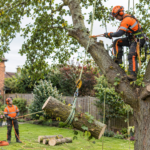
Quick Answer: The person or organisation in control of the land is responsible for its trees. On a commercial site that is usually the owner or occupier, and on a let property it depends on the lease, though landlords normally keep responsibility for trees. That duty holder must take reasonable care that trees do not injure people or damage property, which in practice means a documented, risk-based inspection by a competent person, more often where trees overhang roads, car parks or busy areas, plus prompt action on defects. Broadleaf Tree Surgery provides commercial tree work across Kent, from inspections to remedial work.
After Storm Austen and Storm Boelo brought trees down on Kent roads and railway lines in late October 2026, we have had a steady run of calls from business owners, managing agents and school business managers asking the same thing: “Whose problem is this tree, and what should we have been doing?” This guide answers that, using the law, the court cases that set the standard, and 22 years of hands-on tree work.
This article is general information, not legal advice. For a specific dispute or claim, speak to a solicitor.
What does “duty of care” mean for trees?
Duty of care is the legal obligation to take reasonable steps to avoid foreseeable harm to other people. For trees, it does not mean guaranteeing that a tree will never fail. It means acting as a “reasonable and prudent landowner” would, a test the House of Lords set in Caminer v Northern and London Investment Trust Ltd [1951], where an elm fell onto a passing car. The landowner was not liable because the decay could not have been found even by a careful expert inspection.
The duty comes from several places at once:
- Occupiers’ Liability Act 1957: the occupier owes visitors (customers, staff, pupils, contractors) a common duty of care to keep them reasonably safe, including from falling branches.
- Occupiers’ Liability Act 1984: a narrower duty to people who are not visitors, such as trespassers, where the occupier knows of the danger.
- Negligence and nuisance: the general civil duty not to damage neighbouring property or injure passers-by on roads and pavements.
- Health and Safety at Work etc. Act 1974, section 3: businesses must not expose non-employees to risks from their undertaking, and the Health and Safety Executive (HSE) applies this to trees on business premises.
- Highways Act 1980, section 154: the highway authority can serve notice requiring an owner to cut back or fell a tree that is dangerous to a road or footpath. In Kent that is Kent County Council, and in Medway it is Medway Council.
Who is responsible for trees on a commercial property?
Responsibility sits with whoever has control of the land where the tree’s trunk stands. The table shows how that usually works on the sites we look after across Kent.
| Type of site | Usual duty holder | What to check |
| Owner-occupied business premises (office, factory, shop) | The business that owns and occupies the site | Insurance policy conditions on tree inspection |
| Let commercial unit or business park | Depends on the lease. Common parts and landscaping are usually the landlord’s, often recharged through the service charge | Repair, maintenance and service charge clauses; who controls the area |
| Residential lettings and HMOs | Normally the landlord, who is expected to keep trees safe | Tenancy agreement; tenants usually only handle routine gardening |
| Blocks of flats and managed estates | The freeholder or management company, often through a managing agent | Management agreement; who signs off tree works |
| Schools, academies and colleges | The employer: the local authority, academy trust or governing body | Trust or council tree policy; who on site raises defects |
| Farms, paddocks and equestrian land | Owner, or tenant if the tenancy says so | Tenancy terms; trees along roads and public footpaths |
| Development and construction sites | The developer or principal contractor while in control | Planning conditions and any Tree Preservation Orders |
Two points catch people out. First, a Tree Preservation Order (TPO) does not transfer responsibility to the council: the owner is still liable for a protected tree. Second, responsibility can be shared. A tree on a boundary belongs to both owners, and a managing agent who agreed to arrange inspections and did not can find themselves in the claim alongside the freeholder.
Is the landlord or tenant responsible for trees?
On residential lets, landlords are usually responsible for trees, large shrubs and tall hedges because it is unreasonable to expect a tenant to manage them, a position set out by the National Residential Landlords Association. On commercial leases there is no single answer: it turns on the lease wording and on who controls the area where the tree stands. If the lease is silent and the tree is in a car park or shared landscaping, the landlord is usually the person in control. If a tenant has exclusive use of a yard containing a tree, the lease may well pass the duty to them. Agree it in writing before something goes wrong.
Aaron’s view: “The question I ask on every commercial site visit is simple: who is going to sign the works order? If nobody in the room can answer it, nobody is managing the trees. Settle that first, then talk about inspections.”
How often should trees on a business site be inspected?
There is no fixed legal interval. The courts expect a risk-based approach: the bigger the tree, the more people near it, and the worse the consequences of failure, the more often it should be checked. The HSE guidance (Sector Information Minute SIM 01/2007/05) recommends dividing a site into at least two zones, with periodic checks by a competent person for trees in frequently visited areas.
Two court cases show where the line falls:
- Witley Parish Council v Cavanagh [2018] EWCA Civ 2232: a large lime fell in stormy weather in January 2012 onto a bus on a busy A road. It had been inspected every three years. The Court of Appeal agreed it should have been inspected at least every two years, ideally every 18 months so it was seen both in and out of leaf. The council was liable.
- Parker v National Trust [2021]: a branch fell on a visitor. The Trust had a written tree safety policy, and experts agreed a three-yearly walk-by inspection was reasonable for that zone. The Trust was not liable.
The difference was not the tree. It was whether the inspection regime matched the risk and whether it was actually followed. In practice, most commercial sites in Kent fit a schedule like this:
| Zone | Typical examples | Common inspection interval |
| High use | Trees over roads, pavements, car parks, playgrounds, entrances, bus stops | Every 12 to 24 months, alternating summer and winter, plus after named storms |
| Medium use | Trees by footpaths, staff areas, boundaries with gardens | Every 2 to 3 years, plus after named storms |
| Low use | Woodland edges and areas with little public access | Every 3 to 5 years, or walk-over checks during routine site visits |
Intervals are a guide based on the Witley and Parker judgments, Forestry Commission and National Tree Safety Group guidance. A competent inspector may set a shorter interval for an individual tree with a known defect.
Who counts as a “competent person” for a tree inspection?
Competence depends on the risk. Site staff can do simple walk-round checks for obvious problems if they have been shown what to look for. Trees in high-use zones, and any tree with a suspected defect, should be inspected by someone with recognised arboricultural training and experience, such as a qualified arborist or arboricultural consultant. In Parker, the court judged the inspector against the standard of an “ordinarily skilled tree inspector”. A contractor with a chainsaw ticket but no inspection training does not meet that standard.
At Broadleaf, inspections are led by Aaron, who holds a National Diploma in Arboriculture with distinctions from Merrist Wood College and a Royal Forestry Society Certificate in Arboriculture from Hadlow College. Where a crown cannot be properly assessed from the ground, we use aerial tree inspections by climbing, hydraulic platform or drone. A typical aerial inspection takes 30 to 60 minutes per tree and ends with a written report.
What records should a business keep about its trees?
If a tree fails, your records are your defence. “We had a look” is not evidence. Keep:
- A tree register or plan showing each significant tree, its species, location and risk zone.
- Dated inspection reports naming the inspector and their qualifications.
- Recommended works with priorities and deadlines, and proof each was completed.
- Post-storm checks after every named storm, even a quick note that nothing was found.
- Consents for any work on protected trees (TPO decisions and conservation area notices).
- Contractor paperwork: insurance certificates, risk assessments and method statements.
Many commercial property insurers also expect evidence of tree management, so check your policy conditions. The different types of tree survey are explained in our earlier guide.
What should I do about my site’s trees after Storms Austen and Boelo?
Storms test every tree on a site at once. A tree can survive a storm and still be weakened. Arrange a post-storm check if any tree within reach of people, vehicles or buildings shows:
- Cracked or lifted soil around the base, or a new lean.
- Snapped branches still hanging in the crown (arborists call these “hangers”).
- Splits in the trunk or at a fork.
- Fungal brackets on the trunk or at the base, which can signal internal decay.
- Ash trees with thinning, dying crowns. Ash affected by ash dieback becomes brittle and drops limbs, and it is the most common high-risk tree we find on Kent business sites.
Fence off anything that looks unsafe until it has been inspected. If a tree has already come down, our guide to what to do when a tree has fallen in a storm in Kent covers the first 48 hours. Our explainer on why trees fall over in a storm covers the biomechanics.
Aaron’s view: “Winter is the best time to inspect. With the leaves off you can see every fork, crack and old wound in the crown. If your site trees have not been looked at since the October storms, now is the time, before the spring nesting season makes some work harder to schedule.”
What happens if a business ignores tree safety?
The overall risk from trees is very low. The HSE estimates that between 5 and 6 people are killed in the UK each year by falling trees or branches, about 3 of them in public spaces, and puts the risk at around one in 10 million for trees in or next to areas of high public use. Research for the National Tree Safety Group found around 55 accident and emergency visits a year from being struck by trees.
Low risk is not no risk, and when it goes wrong the consequences are serious. In one HSE prosecution, a council was fined £280,000 after a six-year-old girl was killed by a falling tree at a school. Civil claims for damage to cars, buildings and people are far more common, and the first question the other side asks is “when was this tree last inspected, and by whom?”
The answer is not to fell every large tree. The NTSG and HSE both stress a balanced, proportionate approach, because trees bring shade, biodiversity and value to a site. A reduction, deadwood removal or bracing is often enough. Felling is for trees that cannot be made reasonably safe.
What does Broadleaf provide for commercial clients?
Our commercial clients include construction companies, schools, colleges and academies, property and facilities management companies managing multiple sites across Kent and the London boroughs, and landscaping firms who need sites prepared. For them we provide:
- Ground-level and aerial tree inspections with a written report and prioritised recommendations.
- Remedial work: deadwood removal, crown reductions, crown lifting over car parks and roads, bracing and, where needed, tree felling and removal.
- Local authority checks before every job, with TPO and conservation area paperwork prepared at no extra cost.
- A 24-hour emergency call-out for commercial clients.
- All waste removed: woodchip is composted on a local Kent farm, and we run our saws on 100% biodegradable chain oil and low-emission Aspen fuel.
- CHAS and SafeContractor accreditation, £5 million insurance and a 100% safety record, with risk assessments and method statements supplied for your records.
Before you hire anyone for site tree work, our 12 questions to ask a tree surgeon is a useful checklist.
Frequently asked questions
Who is responsible for trees on commercial property in the UK?
The owner or occupier in control of the land where the tree grows. On let property it depends on the lease, but landlords usually keep responsibility for trees in common areas. The duty holder must take reasonable care that trees do not injure people or damage property.
How often should trees on a business site be inspected?
There is no fixed legal interval. Trees over roads, car parks and busy areas are commonly inspected every 12 to 24 months, medium-risk trees every 2 to 3 years, and low-risk trees every 3 to 5 years, with extra checks after storms. In Witley v Cavanagh (2018) a three-year cycle was too long for a large roadside lime.
Is a landlord or tenant responsible for trees on a commercial lease?
It depends on the lease wording and who controls the area. Trees in car parks and shared landscaping are usually the landlord’s, often recharged through the service charge. A tenant with exclusive use of an area may take on the duty if the lease says so.
Am I liable if a tree on my land falls on a car?
Only if you were negligent, for example if a defect was visible on a reasonable inspection or you had been warned and did nothing. If the tree looked sound and had been properly inspected, a failure in a storm is usually treated as an accident.
Do I need permission to work on a protected tree on my business site?
Yes. Trees with a Tree Preservation Order need consent from your local council, and trees in a conservation area need six weeks’ written notice. The owner remains responsible for the tree’s safety even when it is protected. See our guide to Tree Preservation Orders.
Does a business need a tree survey?
Any business with trees near people, vehicles or buildings should have them inspected by a competent person and keep the report. A written inspection is the best evidence that you met your duty of care.
Who do I call about a dangerous tree near a road in Kent?
If it is on your land, call a qualified tree surgeon to make it safe. If it is blocking or endangering a road, report it to Kent County Council Highways (or Medway Council in Medway). KCC asks owners of trees near roads to have them regularly inspected.
Book a commercial tree inspection in Kent
If you manage trees on a business site, school, estate or rental portfolio in Maidstone, Medway, Gravesend, Sittingbourne, Sevenoaks or elsewhere in Kent, Broadleaf Tree Surgery can inspect them, give you a written report and carry out the work. We hold a 5.0 Google rating from 157 reviews and have worked across Kent since 2015. Call 0800 999 5323 or request a free site visit, and see our commercial tree work service for more on how we work.